
Redwood City's City Directory Shelf
The verified Redwood City directory collection is strongest when the year, holder, and access path are recorded together. The Karl A. Vollmayer Local History Room has the local run from 1907 through 1965 and a 1979 volume. The San Mateo County Historical Association documents an R.L. Polk run from 1920 through 1976, but a publisher label should be assigned volume by volume. Newspapers, maps, voter logs, and tax rolls add the context that a directory entry alone cannot supply.
| Collection | Years or Extent | Where Held | Access |
|---|---|---|---|
| Redwood City directories | 1907-1965 and 1979 | Karl A. Vollmayer Local History Room | Noncirculating; appointment |
| R.L. Polk Redwood City directories | Documented run 1920-1976 | San Mateo County Historical Association research library | Consult the research library; verify each volume |
| Hardbound local newspapers | 1867-1952 | Vollmayer Local History Room | In-room historical research |
| Newspaper microfilm | 1861-1979 | Vollmayer Local History Room | Appointment and reader access |
| Digitized Times-Gazette | 1867-1899 | Redwood City local-history collection site | Remote text search where OCR permits |
| Sanborn maps and local maps | 1919 with 1959 revisions; maps 1860s-1950s | Vollmayer Local History Room | In-person map and address research |
| Voter logs and tax rolls | Voter logs 1920s-1940s; tax years not specified | Vollmayer Local History Room | Collection access and source comparison |
| Photographs and special files | 6,200-plus photographs; Schellens, mortuary, burial, and Morrish materials | Vollmayer Local History Room | Appointment; use as corroborating clues |
The table separates verified holdings from assumptions. A named R.L. Polk example exists for 1965 and another for 1976, but it is not accurate to call every Redwood City volume Polk without opening the title page and publisher information. Missing years also do not prove that a household disappeared. Use the nearest editions on both sides of a gap.
Redwood City Directory Research Room
The Karl A. Vollmayer Local History Room is at the Downtown Library, 1044 Middlefield Road, Redwood City. Local History Room visits are arranged by appointment through 650-780-7030 or localhistory@redwoodcity.org. The material is noncirculating. Most items can be photocopied on request when collection rules allow, but a researcher should plan to read the book, film, or map in the room and capture its title page before copying an entry.
The library’s Vollmayer collections page is the right starting point for a local directory request. Give staff the names, addresses, and date range in advance. Ask which directory volumes, Sanborn sheets, voter logs, tax rolls, or newspaper reels are ready. The broader library page lists general hours, but the appointment contact controls Local History Room access.
The room contains more than directory volumes. Hardbound newspapers, microfilm, maps, photographs, private papers, oral histories, cemetery and mortuary materials, and local event files create a set of independent clues. A directory connects a name to a printed address; a newspaper can explain a move, death notice, business change, or public event around the same date.
The collection page shown below identifies the local-history shelf that anchors historical Redwood City address research.
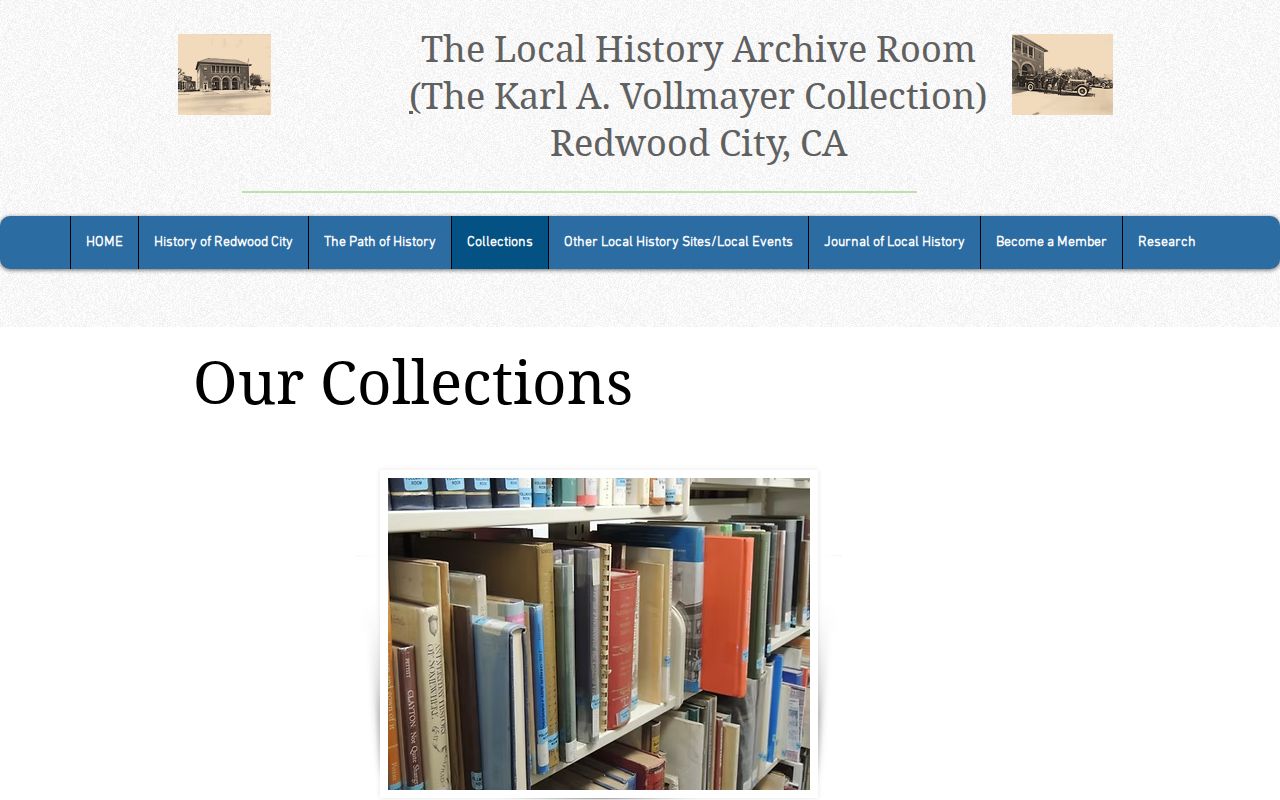
The local-history collections are a reading-room resource, not a circulating directory service. Keep the appointment contact and the volume citation with every transcription.
Redwood City Polk Directory Years
San Mateo County Historical Association research material documents an R.L. Polk run from 1920 to 1976. The evidence includes Polk’s Redwood City Directory examples for 1965, published in Los Angeles, and 1976, published in El Monte. Those examples confirm the publisher for those editions. They do not establish that every year in the broader local shelf carries the same imprint.
Use the Historical Association research library for its own holding and access instructions. The San Mateo County Genealogical Society is a separate county-focused supplement with indexes, a library, research resources, and volunteer knowledge. Verify current hours and services before a visit, and do not substitute an index summary for the title page or page image of the volume used.
The genealogical society’s resource page provides a useful companion route for a local directory search:
A society index can help locate a name or year, while the historical association or library volume supplies the context needed to read the original entry and its abbreviation key.
Redwood City Newspapers for Directory Research
The local resident trail begins earlier than the first verified city directory. Redwood City’s organized library history reaches to an 1865 private subscription reading room shared with the Times-Gazette. Newspaper microfilm begins in 1861, hardbound local newspapers run from 1867 to 1952, and the digitized Times-Gazette collection reaches from 1867 to 1899. The dates make a useful story: a researcher can move from an early reading room, through a long newspaper chronology, to the directory start in 1907.
Search OCR with a surname, street variant, initials, and likely event terms. Then inspect the printed page because OCR can miss names, punctuation, and line breaks. Legal notices, social items, advertisements, obituaries, school notes, and organizational news can explain why a directory listing changes. They are clues, not certified proof of identity or address.
For each newspaper hit, record the title, issue date, page, column, exact spelling, and the address or relationship wording. Pair it with the closest directory edition and a second source such as a voter log, assessment roll, map, or cemetery file.
Reading Redwood City Directory Entries
A sample Redwood City entry schema remains a documented research gap. No authoritative digitized page was opened during the research run, so spouse notation, occupation, owner or renter marks, widow abbreviations, and reverse-directory arrangement must be inspected in the physical volume and its own key. The safe practice is to inventory what appears instead of filling a familiar template from another city.
Use the following inventory when a volume is open. It distinguishes items worth checking from fields that have not been locally verified:
| Name and initials | Copy the printed spelling, initials, and any punctuation exactly; do not silently expand a name. |
|---|---|
| Street address | Record house number, street wording, apartment or unit wording, and the page citation. |
| Spouse notation | Inspect the volume to see whether a spouse appears and how the notation is keyed; it is not verified across all runs. |
| Occupation | Check whether an occupation is printed and whether the volume defines its abbreviation; do not assume every edition has one. |
| Owner or renter mark | Look for a local symbol or letter only after inspecting that edition’s key; no universal Redwood City mark is established. |
| Reverse arrangement | Confirm whether a street-order or criss-cross section exists in that volume before relying on it. |
- Criss-cross directory
- An address- or street-ordered section that can be used to move from a place toward a printed name. Its presence and format must be checked by edition.
- Householder index
- A name-focused entry point for people associated with an address or household. The exact local arrangement is a volume-by-volume question.
- Abbreviation key
- The volume’s own explanation of short forms and marks. Photograph or transcribe it before interpreting an entry.
Note: A directory entry is a dated association with a printed address, not a complete household census or proof of current presence.
Redwood City Sanborn Maps and Directory Addresses
Sanborn fire-insurance maps help test whether an old directory address still points to the same structure. The Vollmayer holdings include a 1919 Sanborn edition with 1959 revisions, and local research also cites maps from the 1860s through the 1950s. A Sanborn sheet can show a building footprint, use, lot relationship, and street context. It cannot by itself name every person who used the structure.
Compare a directory address with the Sanborn sheet, a recorded map, a permit chronology, and the nearest newspaper notice. If a street number or parcel label no longer fits, follow lot, block, map, and legal-description clues. No verified year for a citywide street-renumbering event was located, so an unexplained mismatch should remain a research question rather than a made-up date.
Historic preservation work often layers directories, assessor records, permits, Sanborn maps, aerials, and newspapers. The same method helps a local directory researcher separate a printed address association from a building that changed use or form.
Redwood City Family-History Directory Endpoints
Several local collections close a family-history trail when a volume stops. Layng and Tinney mortuary books, James Crow coroner and burial material, and the Union Cemetery index can add a death or burial clue. Schellens newspaper-extract files reach into the 1860s. The Morrish Collection preserves World War II-era Japanese American citizen and community records that a general directory may miss. More than 6,200 photographs can place a person, street, organization, or building in a visual setting.
These sources have different custodians and different levels of description. A photograph can show a face or building but not prove the date unless its caption and collection record support it. A mortuary or cemetery index can point to a family relationship while the county vital-record office controls any certified copy. Use the local history appointment contact to ask which file or index is available for the date range.
For a person who appears in one local volume and then vanishes, search the next edition, newspapers, voter logs, tax rolls, probate or court clues, and burial material before concluding that the person left the area.
Redwood City City Directory Timeline
The local record story is one of layered institutions. The dates below show why directory research works best when a book is paired with a newspaper, map, or public roll from the same era.
- 1861: Local newspaper microfilm begins in the Local History Room holdings.
- 1865 and 1867: A private subscription reading room shared with the Times-Gazette marks an early organized local reading service; hardbound local newspaper coverage and the digitized Times-Gazette run begin in 1867.
- 1907: The verified Redwood City directory run begins in the Vollmayer collection.
- 1920: The Historical Association’s documented R.L. Polk run begins, subject to volume-level publisher checks.
- 1959: Revisions to the local 1919 Sanborn material add a later structure and address comparison point.
- 1979: The Vollmayer directory holding includes this later local edition after the 1907-1965 run.
- 2026: Public federal census access reaches through 1950 under the 72-year rule, adding household snapshots to earlier directory work.
Trace a Redwood City City Directory Household
Begin with the closest known name or address, then build a dated chain rather than a single hit. The goal is to explain an appearance, move, name change, or disappearance with two or more independent sources.
- Choose the nearest directory year between the Vollmayer run of 1907-1965 and 1979 or the Historical Association’s documented 1920-1976 material.
- Copy the entry exactly, including spelling, initials, street wording, page, volume title, and the abbreviation key. Do not fill an unverified spouse, occupation, or owner mark from memory.
- Check the prior and next available editions. A missing listing can mean a move, death, name change, unlisted person, or a gap in the collection.
- Pair the directory with 1920s-1940s voter logs and tax assessment rolls. A printed listing suggests address association, while assessment and deed evidence address ownership.
- Compare the public census through 1950 for household members, age, birthplace, relationship, occupation, and enumeration location.
- Search Times-Gazette or Tribune material, Schellens files, mortuary books, coroner and burial indexes, and cemetery sources for life events.
- Layer the 1919 Sanborn sheet and 1959 revisions with maps, permits, and deeds when the question concerns a house rather than a name alone.
If a historical find needs a modern address-keyed check, use the Redwood City Street Directory workflow for parcel and deed context. If the question narrows to one living or recently indexed person, the Redwood City Resident Lookup page separates court, vital, voter, license, and business records by what each can actually confirm.
Write down the source, date, page, and access channel for every conclusion. That small citation habit keeps a directory clue traceable when a later volume appears to disagree.