
Redwood City Previous Residents by Era
One address needs different keepers at different points in time. The current parcel is the anchor. The county assessment roll can identify an assessed owner, RecorderWorks can locate recorded instruments from 1985 forward, and older books or fiche extend the deed trail when staff confirm the true cutoff. Local directories and historical collections then test who was associated with the address, rather than assuming the grantee was the occupant.
| Source | Years It Covers | Where Held | What It Shows |
|---|---|---|---|
| Community GIS and assessment roll | Current parcel and annual roll | City GIS; Assessor counter, 555 County Center | APN, situs, map, assessed owner, values, exemptions |
| RecorderWorks | 1985 forward | Recorder Division online index; counter copies | Indexed parties, document type, date, APN when indexed, book/page and number |
| Legacy recorder books and fiche | Pre-1985; remote cutoff unverified | Recorder public terminals and office | Older grantor-grantee entries, images, book and page references |
| Redwood City directories | 1907-1965 and 1979 | Vollmayer Local History Room | Names paired with addresses across directory years |
| R.L. Polk directories | 1920-1976 | San Mateo County Historical Association research library | Additional name and address coverage; volume-by-volume checking is needed |
| Newspapers and voter logs | 1861-1979 microfilm; 1920s-1940s logs | Local History Room | Moves, notices, obituaries, civic presence and address clues |
| Census, Sanborn, permits | Census through 1950; 1919 Sanborn with 1959 revisions; permit history varies | Library, archives, and Redwood City eTRAKiT | Household snapshots, structures, use, work and address changes |
Start with the era that matters. A modern transfer belongs in the county recorder chain. A 1940 household may require a directory, voter log, census page, and newspaper check. A much older address may need maps and legal descriptions because the street number or parcel label changed.
Start Redwood City Previous Residents with Parcels
The strongest first move is to search the current address in Redwood City Community GIS. Capture the nine-digit APN, parcel geometry, situs address, assessor-map link, and any subdivision or recorded-map reference. Then check the public Local Assessment Roll at the Assessor counter at 555 County Center. It can identify the assessed owner, values, and exemptions, but an assessed owner is not automatically the person who occupies the parcel.
- Write the address exactly as returned by GIS, including any unit or directional element, and note the city jurisdiction.
- Save the APN without dashes, since the county map and RecorderWorks instructions use a nine-digit format.
- Open the assessor map result and copy the book, page, volume, lot, block, or subdivision references available.
- Separate situs, mailing address, and legal description in the research notes. A tax mailing address can point elsewhere.
- Carry the parcel and legal description into RecorderWorks, then compare the recorded chain with historical address sources.
That parcel-first method protects against a common break in a previous-resident search. A street address can be reused, renumbered, divided, or attached to a new parcel. A legal description and recorded map are more durable than a mailing line. The result is a traceable address history, even when a name search produces several similar people.
Trace Redwood City Previous Residents Backward
San Mateo County grantor-grantee guidance describes RecorderWorks as the computerized property-document index for 1985 forward. Search the current assessed owner in LAST FIRST form, allow a partial match when needed, narrow the date range, and add the APN or document type. A deed, deed of trust, reconveyance, lien, easement, or probate-linked instrument can explain a recorded relationship with the parcel. It does not, by itself, prove residence.
- Locate the likely acquisition document and record its document number, parties, type, date, APN, book/page, and page count.
- Read the buyer as grantee and the seller as grantor. Search the seller as a grantee to find the prior acquisition of the same land.
- Repeat backward while checking the legal description and any prior-instrument reference against the parcel map.
- Follow trusts, estates, affidavits of death, successor-trustee documents, decrees of distribution, and quitclaims with care.
- Move to legacy indexes, fiche, and public terminals before 1985, and ask the Recorder Division to confirm the remote cutoff.
- Grantor
- The person or entity transferring an interest in a recorded instrument.
- Grantee
- The person or entity receiving the interest named in that instrument.
- Chain of title
- The linked sequence of recorded transfers used to connect a parcel through earlier interests.
- Legal description
- The lot, block, map, or other land description that can outlast a street-number change.
The county does not remotely display RecorderWorks document images. Index rows are locators. For a consequential family or parcel conclusion, inspect the actual copy and preserve the legal description.
The county grantor-grantee instructions show the name-index route for a Redwood City previous residents investigation.
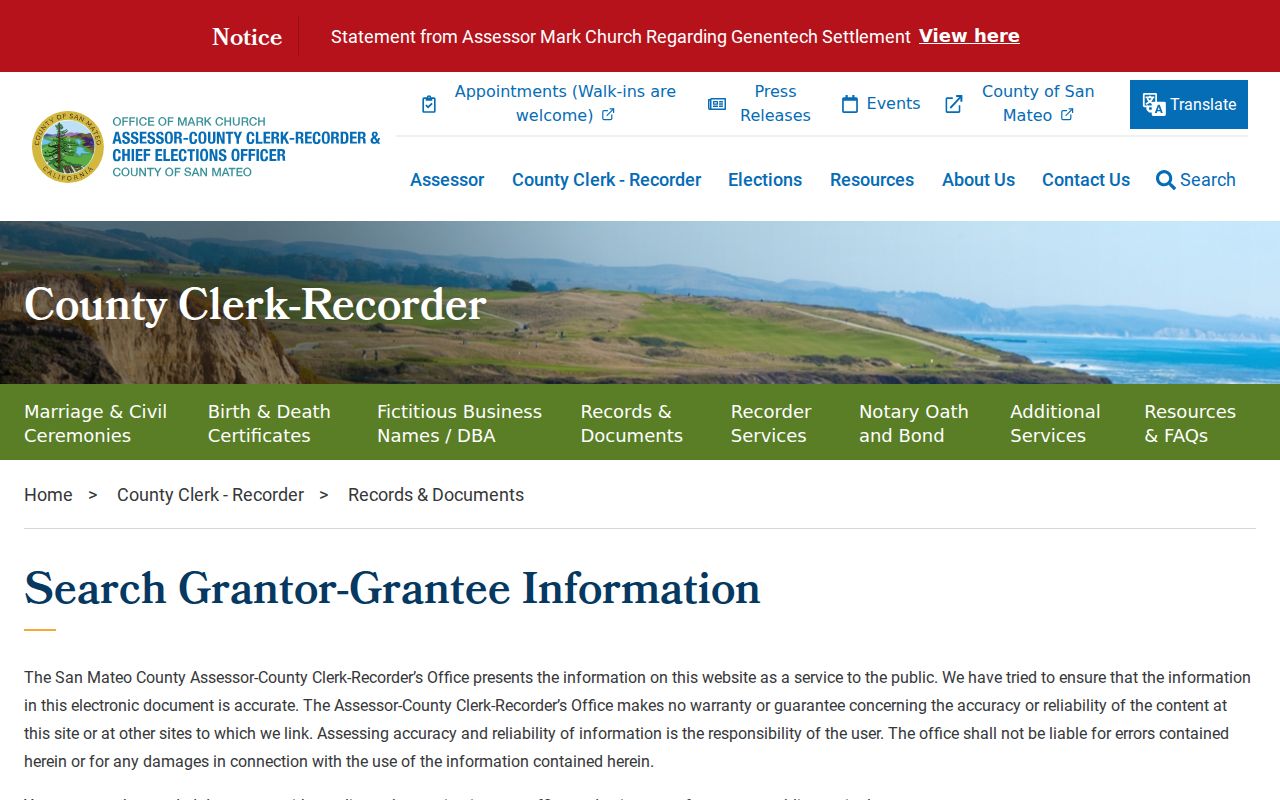
The guidance image is a reminder that a name search and a title conclusion are different steps. Keep both the indexed row and the document request trail.
Redwood City Previous Residents and Deeds
When the indexed row matters, the Recorder Division provides counter and mail routes. At 555 County Center, public terminals permit free viewing. A mailed request needs the parties, document type, recording date or number, payment by a qualifying check or money order, and a self-addressed stamped envelope sent to the ACRE Customer Service Desk. The county's recorded-copy instructions describe the request path.
The San Mateo County copy-order instructions show how a Redwood City previous residents researcher can move from an index row to a paper or counter copy.
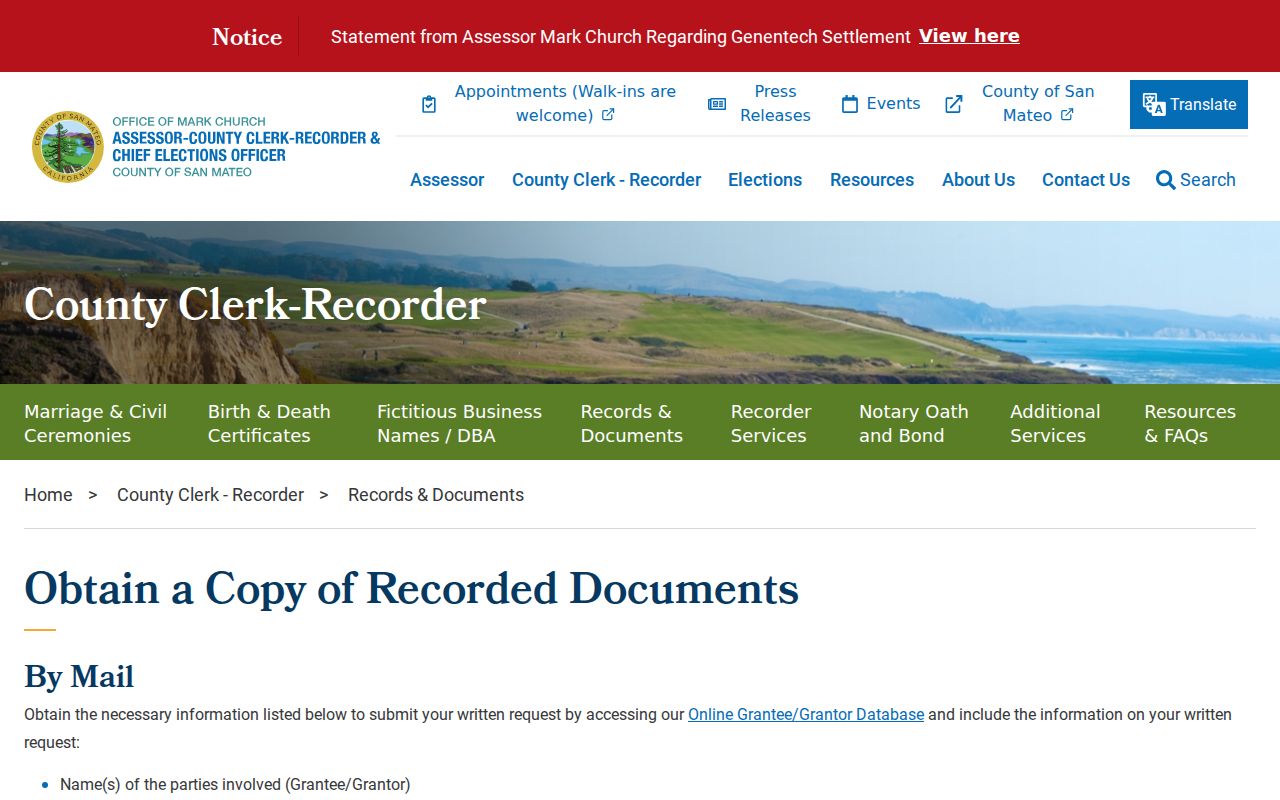
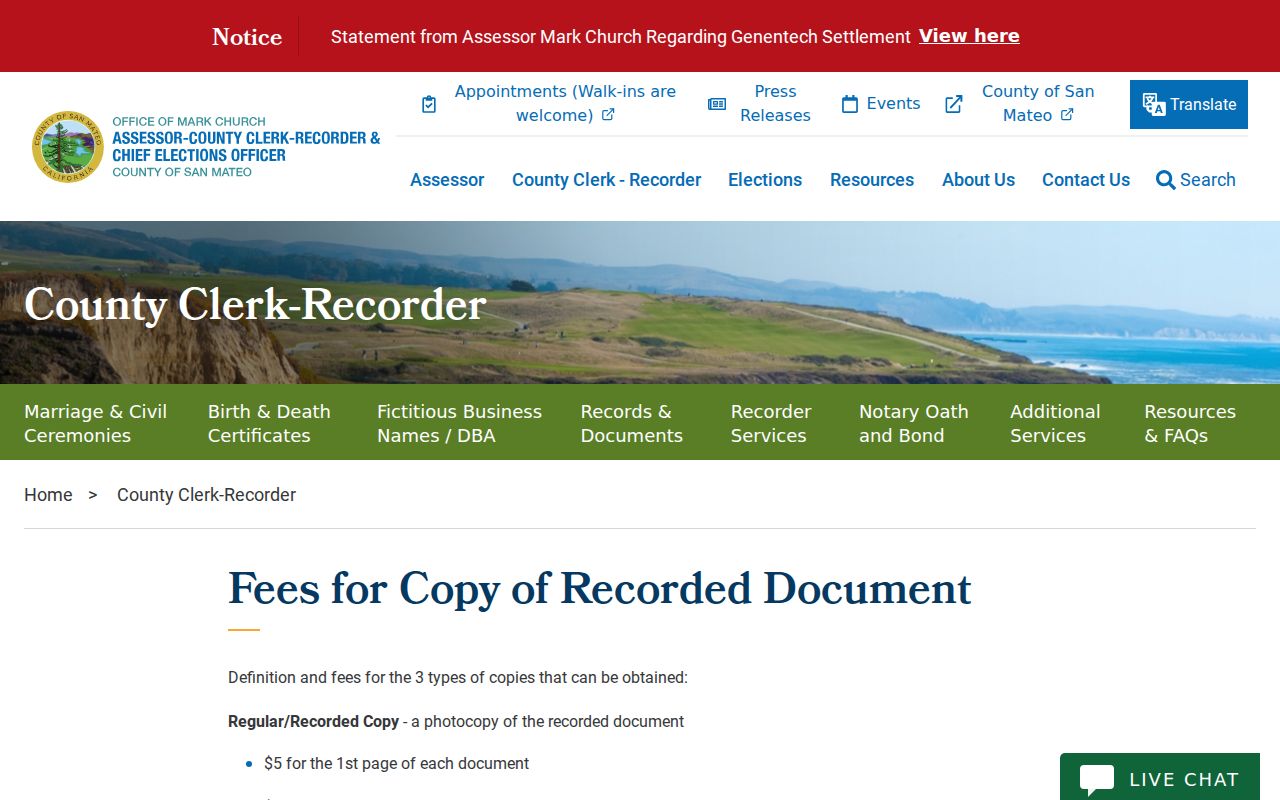
Current county guidance lists $5 for the first page and $1 for each additional page, with $5 for certification and $10 for a conformed copy. Confirm the current amount before sending money because fees and request methods can change. The recorded-document fee schedule is the controlling reference for an order.
The San Mateo County copy-fee page gives the cost context for obtaining a Redwood City previous residents record from the recorder.
A quitclaim is not automatically a sale, and an affidavit or decree can reflect an estate event rather than a move. Read the instrument type before assigning a person to a year of occupancy.
Redwood City Directories Test Previous Residents
The Redwood City Local History Room holds directories from 1907-1965 and 1979. The San Mateo County Historical Association documents R.L. Polk material from 1920-1976, including cited 1965 and 1976 editions. These holdings are valuable because they pair names with addresses, but each volume's own key must be checked. The exact local schema for spouse, occupation, owner marks, and reverse entries was not verified from an authoritative digitized page.
Copy the entry exactly, including initials, spelling, address, and printed abbreviations. Compare the closest prior and next editions. A missing listing can mean a skipped volume, a spelling difference, a move between publication dates, or a changed address. Directory evidence suggests an address association. Deeds and assessment records answer ownership. A census or voter log adds a separate household or civic snapshot.
The Vollmayer Local History Room collection guide identifies the directory shelf used to trace Redwood City previous residents by address. The materials are noncirculating, so arrange an appointment at 650-780-7030 or localhistory@redwoodcity.org and record the edition year and page with each entry.
Family Endpoints for Redwood City Previous Residents
Family-history trails often end in a death, marriage, or probate event. San Mateo County Clerk-Recorder issues county birth, death, and marriage certificates; the county birth and death information explains the local route, while the California Department of Public Health handles statewide certificate services. Certified informational copies are available under the documented rules, but authorized certified copies require a qualifying relationship and sworn statement. Confidential marriage copies are limited to the parties or a court order.
The San Mateo County birth and death certificate page shows the official endpoint for a Redwood City previous residents family-history lead.
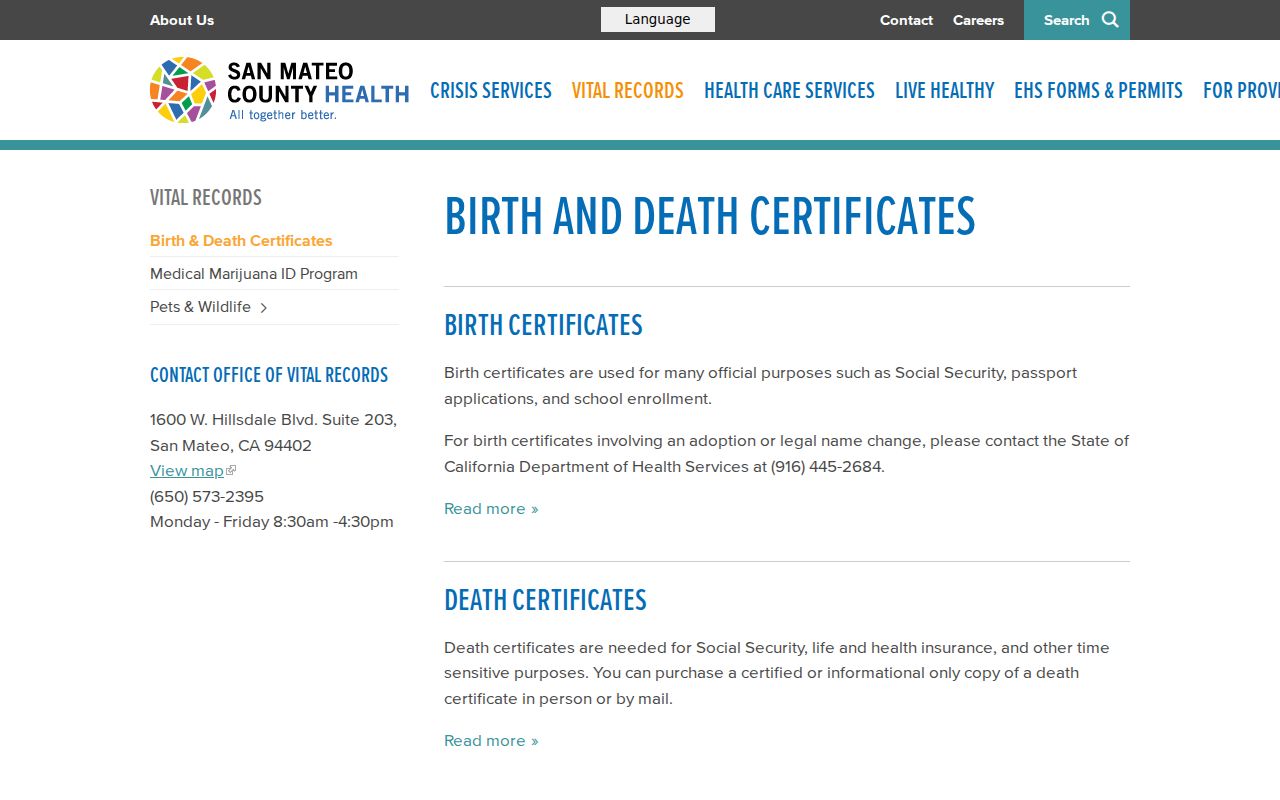
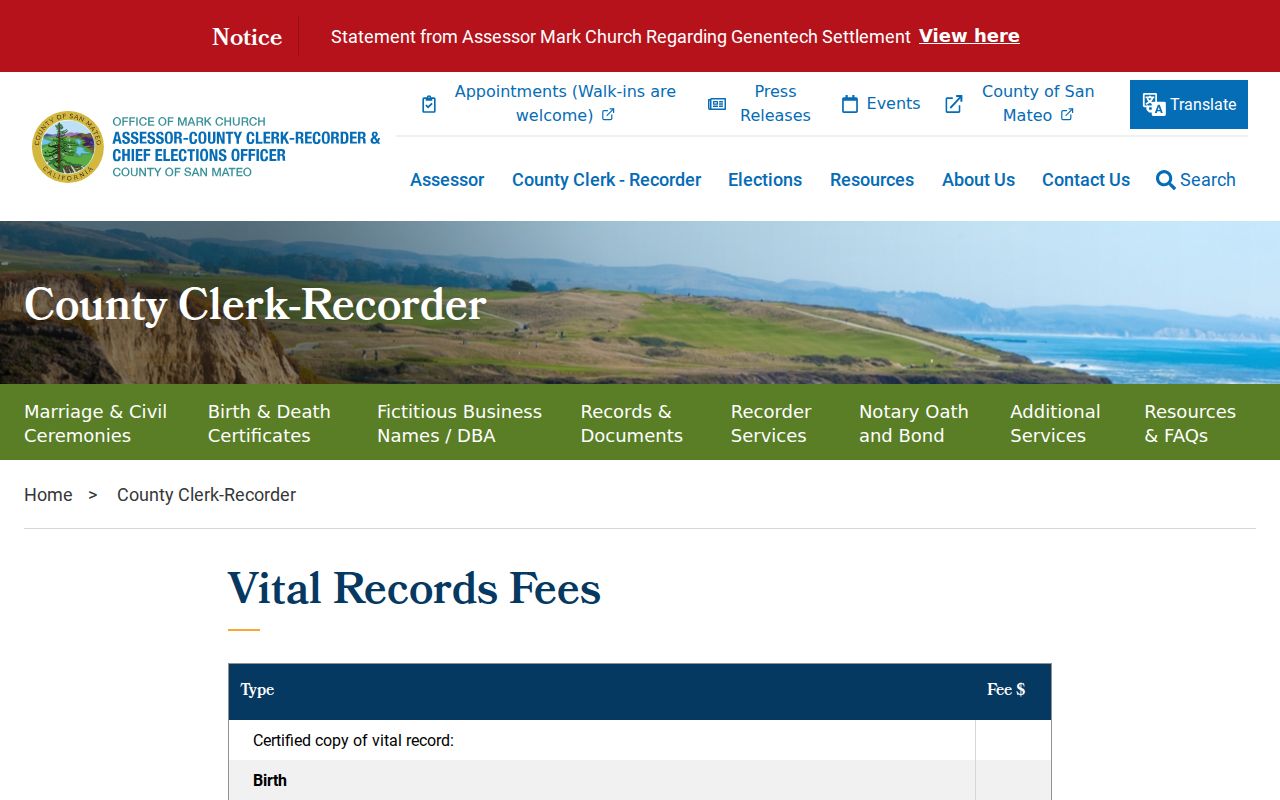
County fees are currently $34 for birth, $26 for death, $23 for fetal death, and $19 for marriage. A no-record search costs the same and returns a Certificate of No Public Record. Do not apply a blanket age-opening rule to California birth records. The eligibility path, record type, and relationship control access.
The San Mateo County Clerk-Recorder vital records gateway connects a Redwood City previous residents inquiry to county forms and record-specific instructions.
Local-history materials can fill the clue layer. Layng and Tinney mortuary books, James Crow coroner and burial material, the Union Cemetery index, newspapers, and the Schellens files may close a family-history trail when a public certificate is restricted. They are historical clues, not substitutes for a certified record.
Redwood City Previous Residents, Maps, Permits
Address continuity is not only a name problem. The Local History Room holds a 1919 Sanborn fire-insurance map with 1959 revisions, and local research also cites older Sanborn editions and aerials at several repositories. Sanborn sheets show building footprint and use. They can test whether an old number refers to the same structure, but they do not identify every occupant.
Redwood City eTRAKiT accepts address or APN searches for permits and projects. Project details may include site information, contacts, fees, inspections, conditions, reviews, and chronology. A permit applicant, architect, contractor, or other contact is not automatically an owner or occupant. Compare the date and description with the deed, map, and directory trail.
When an APN changes after a split or merger, return to recorded maps and the deed's lot, block, and legal description. That is the practical insider tip: APN continuity is useful, but it is not guaranteed across the full history of a Redwood City parcel.
Census Pairing for Redwood City Past Residents
Federal census records remain public through 1950 under the 72-year rule in the research record. A census page can show household members, age, birthplace, relationship, occupation, and enumeration location at one point in time. It should be paired with the nearest available directory, not used as a perfect annual register. A directory can place a name at an address between census years; the census can test household composition when the address is identifiable.
- Transcribe the directory entry and its year, then locate the nearest census year and enumeration location.
- Compare names, ages, relationships, and street wording without forcing a match on surname alone.
- Use voter logs from the 1920s-1940s and tax rolls to add another time-stamped address clue.
- Search local newspapers from 1861 microfilm and 1867-1952 hardbound runs for notices, moves, deaths, and social items.
- Mark each fact as ownership, occupancy, family connection, or historical context so the conclusion stays precise.
The local trail reaches back farther than a modern online index. The 1865 reading room, 1861 newspaper microfilm, 1907 directory start, 1920s voter logs, and 1985 computerized deed index form an institutional layer rather than one seamless database.
Privacy for Redwood City Previous Residents
Previous residents research is strongest when it stays tied to a parcel, a dated source, and a lawful personal purpose. Public records may omit household members, protect a person through Safe at Home, or withhold court and vital material. A name in a deed, directory, obituary, or permit is not a license to infer a current address or demand contact.
Lawful use. Redwood City house history supports genealogy, estate research, property curiosity, and personal reconnection. Do not use a previous-resident trail to stalk, threaten, track, or harass a living person.
Write down the portal, search mode, dates, spelling variants, and negative results. When a record is missing, consider a protected address, a sealed file, a legacy index, an APN change, or a name variation before treating the gap as proof that someone was never there.
Note: A deed establishes a recorded interest, while a directory, census, or local-history source may establish only an address association.